
I knew four great grandmothers. I recorded none of them.
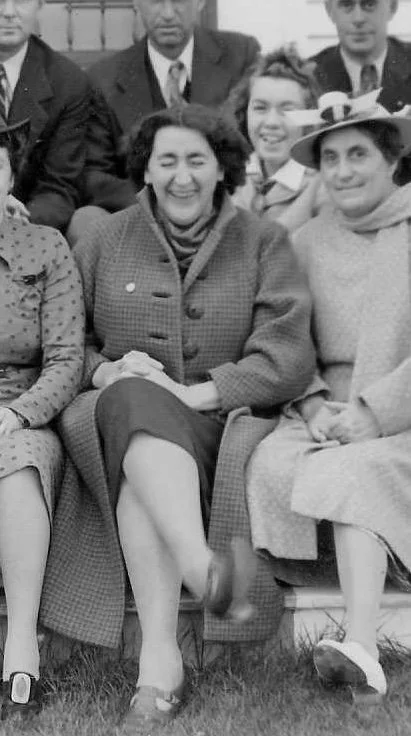
Mag McEacharn laughing in a family photo from the late 1930s or early 1940s.
My great-grandmother Marguerite “Mag” McEacharn had opinions about clam chowder and about everything else worth having opinions about. I can still see her in her Maine kitchen, apron covered in flour, cavalierly tossing a full stick of butter into a steaming pot with a triumphant "THERE" and adding, in her thick Down East accent and with absolute certainty, "If it doesn't have a pound of butter, it's not a bit of good."
I knew her well. I loved her. She lived into her mid-nineties, and she died when I was twenty-one — old enough to have known that life is short, but young enough not really believe it yet.
And I never recorded a single word she said.
As a child, Mag worked in a sardine cannery on the coast of Maine in the early 1900s — a child laborer (like most of us have only seen in the famous Lewis Hine photos). She carried that history in her body, in her hands, in the particular way she moved through a kitchen with both meticulous precision and reckless abandon. She had stories I glimpsed only in fragments, in passing, in the way stories get told around the kitchen table, when kids like me are breezing in and out and only half paying attention.
I actually knew four of my great-grandmothers. Four. That is an extraordinary thing, and I did not fully understand how extraordinary it was until they were gone. Two of them lived nearly 100 years and I shared two of those decades with them. I had time.
Ten states away on the coast of North Carolina, in another great-grandmother’s kitchen (this one more likely frying chicken livers or baking cornbread) I heard stories that my great grandmother Ivy Lynn Rawls told about her grandfather…a man who had fought in the Civil War. She had heard those stories directly from the man who lived them, which means I was two conversations away from the Civil War. And I never thought to record her telling me about what her grandfather had told her.
I was a “baby historian” by the time they died, about to start my graduate studies in oral history. I knew, in the abstract, that primary sources mattered. I knew that living memory was irreplaceable. I just didn't understand yet that the most important primary sources in my life were sitting across from me at kitchen tables, waiting to be asked.
And here’s the thing about oral history — we almost never lose these stories because we don't care. We lose them because we assume there will be time. Because we don't want to bring up the specter of a loved one’s death or seem morbid. Because we think the stories will always be there, just as it feels like the person we love will always be there — until suddenly, one day, they aren't and we are left with fragments of their story.
An entire stick of butter, tossed into a pot with absolute conviction. A thick Down East accent. A triumphant "THERE."
I have that. I am grateful for that. But I don't have her voice on tape. I don't have her telling me about the cannery, about what her hands smelled like after a shift, about what it felt like to be a child doing a grown woman's work on the coast of Maine in 1908. I don't have her telling me what she was afraid of, what she was proud of, what she wished had been different.
Those stories died with her. But they didn't have to.
If you are reading this and you still have someone — a parent, a grandparent, an aunt or uncle, a chosen-family elder — who carries stories you have never fully heard, I want to say this as simply as I can: the time to record those stories is now. Not when things slow down at work. Not after the kids are out of school. Not after the holidays. Now.
You don't need expensive equipment. You don't need academic training. You need a phone, a quiet room, and a willingness to ask a real question and then…stop talking.
Ask her what her grandmother’s kitchen smelled like. Ask him to tell you the story of how he got his name. Ask what they want their legacy to be with the next generation. Ask about a lesson they learned the hard way.
You will be amazed at what comes back.
The stories are there. They are waiting. And the window — I promise you — is shorter than it feels.
At Triangle Story Studio, we help families capture the stories that matter most — before they're gone. If you're ready to start, or just want to talk through what's possible, we'd love to hear from you.
