
Isn’t It time You Recorded Your Family’s History?
I've spent decades as an oral historian and public historian, and this summer I'm teaching Exploring Your Family History through Oral History — a six-week online course through Duke's Center for Documentary Studies beginning July 7. If you've been meaning to record your mother's stories, or your grandfather's, or sit down with the aunt who holds the family recipes along with its history, this course was designed for you. And if you've been meaning to do it for years and somehow haven't gotten around to it yet — that's exactly why you need this class.
The barrier to starting a family oral history project is almost never ability or passion. People who want to do this work are usually perfectly capable of doing it. They have the curiosity. They have the relationships. They often even have the equipment — a phone with a Voice Memo app is sitting right in their pocket.
The barrier is structure. And time. And the very human tendency to assume that later will happen. Somehow we imagine that in some future moement, things will slow down and we’ll be less busy so that we can find a stretch of time to finally sit your grandmother down and ask her the questions you've been carrying for years. “I’ll get to it,” we tell ourselves, “later.”
Later, in my experience, does not happen on its own.
Why the cobbler’s kids have no shoes
Even with decades of oral history experience, I never interviewed my own family members until relatively recently, for the same reason that there’s an old cliché about how the cobbler’s kids go barefoot. It’s because it's easier to feel urgency about someone else's story than about the ones closest to you. You can recognize immediately why it matters to interview an 80-year-old veteran or a community elder in their 90s whose memories are irreplaceable. But your own mother? Your grandfather? Somehow that feels less urgent — even when, on some level, you it isn't. The people we love most are the ones we assume will always be there, and so we always assume that we’ll have time some day to have those conversations.
Further complicating the push to get started is that interviewing family is genuinely harder than interviewing a stranger. The pre-existing relationship brings warmth and trust, but it also brings a history, and along with it the sometimes-complicated dynamics between parents and children, between siblings, and so on.
A structured course with a clear assignment cuts through all of that. It gives you a purpose for your interview, a deadline for getting it started, and a clear reason to finally make the call not later, but now.
What you'll walk away with
By the end of six weeks, you'll understand the ethics and best practices of oral history, have practiced your interviewing technique in a supportive environment, know what you need to know about equipment and audio quality, and have a solid plan for a family oral history project. More importantly, you'll have one interview already finished.
That last part matters more than it might sound. One interview is contagious. Like potato chips, you can't have just one. And with one completed interview, you'll have something real to share with your family. That first interview is proof positive that this project is happening, that the stories are really being captured, and that you are really doing this. That energy tends to generate more interviews, more stories, and more people who want to be part of what you're building.
If you might be imagining family history as source material for a podcast this course will give you the foundation you need. Your distant cousins may never sit down and listen to 6 or 8 sixty-to ninety-minute recordings. But they might listen to a curated series of podcast episodes on their commute, and enjoy learning about your family's story in a beautifully rendered way. The raw material and the skills to shape it start here.
The details
Exploring Your Family History through Oral History runs for six Tuesday evenings beginning July 7, 2026, entirely online — which means you can do it from anywhere. (The last course I participated in through CDS had participants from all over the U.S. and from other countries!) Whether you're in the Triangle area of central NC or halfway around the world, you're welcome.
For those who are interested in a broader foundation in documentary studies, this course counts toward CDS’s continuing education certificate.
Registration is open now, with a July 6 deadline. Full course details and registration link are here.
Later is not coming. July is. I look forward to seeing you in class!
What Happens When Your Institutional Memory Walks Out the Door
Imagine a retirement party. The decorations. A sheet cake. Toasts (and roasts) of the retiree. Maybe a slideshow. Bad jokes about throwing away the alarm clock and having more time for golf and the grandchildren. Coworkers share memories and talk about how the guest of honor will be missed. Someone gives a speech about what this person built, what they meant to the organization, what a legacy they're leaving behind.
And then they leave. Maybe they move to Florida or somewhere closer to their grown children and grandkids. Maybe they stay local but disappear into their country club, their book group, their church, or the travel they had put off for years.
And with them goes everything that was never written down.
The job description. The org chart. The strategic plan. Operations manuals. Those things are all safe. They exist in a Google Drive somewhere and the new person in their role will find them. But a lot of very important things will be missing — like how the founding partnership actually came together (the phone calls, the meet-ups at conferences, the disagreements, the leap of faith). What the first year was really like. What they were afraid of, what worked out better than they ever expected, and what they learned along the way. Which funders and collaborators proved to be genuine partners, and which ones proved more trouble than they were worth. The lessons that got learned the hard way that were never documented because everyone thought they'd never forget them.
That's institutional memory. And most organizations are hemorrhaging it continually, retirement party after retirement party, leadership transition by leadership transition.
Most organizations think they're handling this. There's an exit interview. Maybe a transition manual. Maybe the outgoing director agrees to be "available for questions" for the first few months. And those things have value. But they capture what people did and the procedures for doing them, not why they did it and the stories behind that why. They document process, not wisdom.
An exit interview asks, "what are your major responsibilities and who should handle them after you leave?" Oral history asks, "what did you know by the end that you wish you'd known at the beginning? What did you get wrong, and what did getting it wrong teach you? What does this organization believe about itself that isn't written anywhere but is absolutely true?" Those are different questions. They produce different and far more valuable answers.
This is also why it helps to bring in someone from outside the organization to do this work. A departing director will say things to a neutral third party that they would never say in an exit interview — about what went wrong, what they're worried about, what they wish they'd done differently. That candor is exactly what's most valuable, and it's rarely available when the interviewer is also the boss, the board chair, or the successor.
There's also a timing problem. The moment of departure is almost always the wrong moment to do this work. The outgoing leader is emotionally overwhelmed, their successor is anxious to establish their own identity, and nobody wants to make the transition harder by having the old guard too present. So the knowledge transfer gets compressed, rushed, or skipped entirely — and five years later, someone is reinventing a wheel that their predecessor spent a decade perfecting, because nobody thought to document how it was built the first time.
The good news: this work doesn't have to happen at the moment of departure. In fact, it shouldn't.
The best time to do this work is before anyone is leaving — when a founder is still actively leading, when a long-tenured director still has decades ahead of them, when the people who built something are still around to talk about what they built and why and how. You don't need a retirement party on the calendar to start preserving what your organization knows.
What does that look like in practice? It looks like a series of recorded conversations — not interviews in the clinical sense, but real conversations — with the people who carry your organization's history. It looks like asking the questions that feel almost too big to ask. Why did you start this? What almost stopped you? What do you want the next generation of leadership to understand that they won't be able to learn any other way? It looks like creating an archive that isn't just a folder of old grant reports, but a living record of how your organization thinks, decides, struggles, and grows.
It looks like treating your organization's story as worth preserving — not just for an anniversary gala or a capital campaign, but because the people who come after you deserve to know what you built and how you built it.
The sheet cake and toasts are lovely. But they are not a preservation strategy.
If you're a board member, a founder, or an organizational leader who has ever looked around the room and thought we need to capture this before it's gone — that instinct is right, and it's not too late to act on it. Triangle Story Studio works with organizations to document their histories, preserve their institutional knowledge, and create archives that serve the people who come next. Whether you're planning for a leadership transition, approaching a major anniversary, or simply want to make sure your organization's story doesn't walk out the door with the people who lived it, I'd love to talk.
I knew four great grandmothers. I recorded none of them.
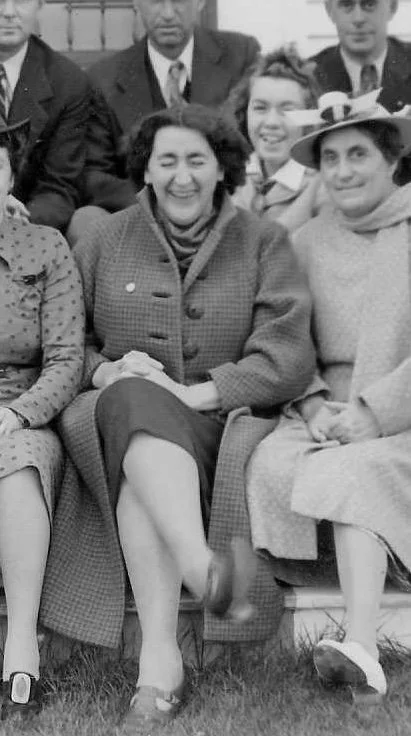
Mag McEacharn laughing in a family photo from the late 1930s or early 1940s.
My great-grandmother Marguerite “Mag” McEacharn had opinions about clam chowder and about everything else worth having opinions about. I can still see her in her Maine kitchen, apron covered in flour, cavalierly tossing a full stick of butter into a steaming pot with a triumphant "THERE" and adding, in her thick Down East accent and with absolute certainty, "If it doesn't have a pound of butter, it's not a bit of good."
I knew her well. I loved her. She lived into her mid-nineties, and she died when I was twenty-one — old enough to have known that life is short, but young enough not really believe it yet.
And I never recorded a single word she said.
As a child, Mag worked in a sardine cannery on the coast of Maine in the early 1900s — a child laborer (like most of us have only seen in the famous Lewis Hine photos). She carried that history in her body, in her hands, in the particular way she moved through a kitchen with both meticulous precision and reckless abandon. She had stories I glimpsed only in fragments, in passing, in the way stories get told around the kitchen table, when kids like me are breezing in and out and only half paying attention.
I actually knew four of my great-grandmothers. Four. That is an extraordinary thing, and I did not fully understand how extraordinary it was until they were gone. Two of them lived nearly 100 years and I shared two of those decades with them. I had time.
Ten states away on the coast of North Carolina, in another great-grandmother’s kitchen (this one more likely frying chicken livers or baking cornbread) I heard stories that my great grandmother Ivy Lynn Rawls told about her grandfather…a man who had fought in the Civil War. She had heard those stories directly from the man who lived them, which means I was two conversations away from the Civil War. And I never thought to record her telling me about what her grandfather had told her.
I was a “baby historian” by the time they died, about to start my graduate studies in oral history. I knew, in the abstract, that primary sources mattered. I knew that living memory was irreplaceable. I just didn't understand yet that the most important primary sources in my life were sitting across from me at kitchen tables, waiting to be asked.
And here’s the thing about oral history — we almost never lose these stories because we don't care. We lose them because we assume there will be time. Because we don't want to bring up the specter of a loved one’s death or seem morbid. Because we think the stories will always be there, just as it feels like the person we love will always be there — until suddenly, one day, they aren't and we are left with fragments of their story.
An entire stick of butter, tossed into a pot with absolute conviction. A thick Down East accent. A triumphant "THERE."
I have that. I am grateful for that. But I don't have her voice on tape. I don't have her telling me about the cannery, about what her hands smelled like after a shift, about what it felt like to be a child doing a grown woman's work on the coast of Maine in 1908. I don't have her telling me what she was afraid of, what she was proud of, what she wished had been different.
Those stories died with her. But they didn't have to.
If you are reading this and you still have someone — a parent, a grandparent, an aunt or uncle, a chosen-family elder — who carries stories you have never fully heard, I want to say this as simply as I can: the time to record those stories is now. Not when things slow down at work. Not after the kids are out of school. Not after the holidays. Now.
You don't need expensive equipment. You don't need academic training. You need a phone, a quiet room, and a willingness to ask a real question and then…stop talking.
Ask her what her grandmother’s kitchen smelled like. Ask him to tell you the story of how he got his name. Ask what they want their legacy to be with the next generation. Ask about a lesson they learned the hard way.
You will be amazed at what comes back.
The stories are there. They are waiting. And the window — I promise you — is shorter than it feels.
At Triangle Story Studio, we help families capture the stories that matter most — before they're gone. If you're ready to start, or just want to talk through what's possible, we'd love to hear from you.
What Is Oral history?
It All Begins Here
A Few Great Places to Start
People often ask, "What exactly is oral history?" The short answer: it's the practice of recording people's lived experiences — in their own words — so those stories can be remembered, shared, and understood in context.
But that short answer doesn't quite do it justice.
Oral history is simultaneously the oldest and newest form of history we have. Human beings have been telling each other their stories since our distant ancestors gathered around communal fires — it is the original way we made sense of the world and passed that sense along. And yet oral history as a formal discipline is only as old as the technology available to record the human voice, which makes it roughly a hundred years old. In historical terms, that's a blink. We have been storytellers forever. We have only recently figured out how to preserve the voice itself.
That matters, because voice is irreplaceable. A document can tell you what happened. A voice can tell you what it felt like, what it meant, and why it still matters.
Oral history is also a radical intervention into whose history gets told. For most of recorded history, the historical spotlight has fallen on presidents, generals, celebrities, and CEOs — the people with power, platform, and access to the archive. Oral history pushes back against that. It insists that everyone has a story worth preserving — not just for their families, not just for their communities, but for history with a capital H. Every person's experience is part of the grand human story. Every perspective adds something that no other perspective can. When those voices go unrecorded, history is incomplete. It's not just a personal loss — it's a collective one.
And then there's the way oral history changes how we talk to each other. In daily life, most of our conversations stay on the surface. "How are you?" "Fine, thanks." We move through our days in a kind of managed disconnect, rarely stopping long enough to really ask or really answer. An oral history interview is something different entirely. It's the kind of conversation you have with a close friend at two in the morning — when the guards come down and the real story comes out. When you commit yourself fully to deep listening, to holding space for someone to tell their story in their own words and at their own pace, something shifts. It's a radical departure from the way we usually move through the world. And it's one of the most profound things you can do for another person — to say, with your full attention: your story matters, and I am here to hear it.
That's what oral history is. That's why it matters. And that's why, done well, it changes both the person telling the story and the person listening.
If you’re curious to learn more, here are a few excellent, widely respected resources to explore:
Oral History Association (OHA)
The professional organization for oral historians in the U.S.
A great place to learn about:
What oral history is (and isn’t)
Ethical guidelines and best practices
How interviews are conducted and preserved
StoryCorps
Known for its intimate recorded conversations between loved ones.
Especially helpful for:
Understanding oral history as a relational practice
Seeing how everyday people can record meaningful stories
Exploring listening as an act of care
ORal History at the American Folklife Center
One of the nation's premier repositories for oral history, the American Folklife Center has been collecting and preserving the voices of everyday Americans for nearly 130 years.
Houses hundreds of oral history collections spanning 115 years, from wax cylinder recordings of the 1890s to contemporary digital audio
Collections include voices of formerly enslaved people, Pearl Harbor eyewitnesses, 9/11 survivors, migrant workers, veterans, and everyday Americans from every walk of life
Home to the Veterans History Project, the largest oral history collection in the nation, with more than 40,000 interviews
Columbia Oral Histoty
A leader in oral history theory and practice.
Helpful if you’re interested in:
The deeper thinking behind oral history
How interpretation and memory work
Oral history in academic, community, and public settings
Southern Oral History Program (UNC-Chapel Hill)
A nationally respected program rooted in community-based work.
Especially relevant for:
Southern history and lived experience
Ethical, collaborative storytelling
Oral history as a tool for understanding social change
Why oral history Matters
Oral history reminds us that history doesn’t live only in textbooks or archives—it lives in people. Voices carry emotion, perspective, and insight that written records alone can’t hold.
Whether you’re recording a parent, documenting a congregation, or preserving an organization’s institutional memory, oral history offers a way to listen deeply and honor lived experience.
At Triangle Story Studio, this belief guides everything we do.
WELCOME TO TRIANGLE STORY STUDIO
WELCOME
Preserving Stories, Connecting Voices
Hello, and welcome to Triangle Story Studio! My name is Kathryn Wall, and I’ve spent decades helping people preserve and celebrate the stories that shape their lives — from family memories to community histories and organizational narratives. After years in academia, freelancing as an oral historian and consultant, teaching, and co-directing the public history program for a Iocal non-profit, I created Triangle Story Studio to make professional oral history-based storytelling accessible and meaningful for families, community groups, and businesses alike.
At its heart, TSS is about one thing: listening carefully and turning treasured stories into lasting legacies. As I often say, the past is what happened long ago, but history is the meaning we make from it — and I firmly believe that every voice matters in shaping that meaning.
For Families
Families carry rich, unique histories, filled with laughter, life lessons, and generational stories worth preserving. Whether you want a single interview capturing a cherished memory, a multi-session series spanning generations, or guidance on how to document your family history yourself, TSS can help. We can even create podcast-style narratives, photo-and-audio slideshows, or custom storybooks to share and treasure for years to come.
For Community Organizations
Nonprofits, schools, churches, and local groups have stories that define their culture and connect them to the communities they serve. TSS works with organizations to record oral histories, produce public-facing storytelling projects, prepare archive-ready documentation, or consult on project design. The result is a collection of voices that honor your mission, preserve institutional memory, and strengthen community identity.
For Businesses and Institutions
Businesses and larger organizations can benefit from oral history to capture leadership insight, preserve organizational culture, document milestones, or create engaging content for clients and stakeholders. TSS brings professionalism, discretion, and storytelling expertise to every project, transforming interviews into polished, meaningful narratives that resonate inside and outside your organization.
Why Triangle Story Studio?
What sets TSS apart is simple: care, skill, and attention to the dignity and value of every human story. With more than 30 years of experience, including a PhD in history and years of oral history interviewing experience, I combine professional expertise with warmth and compassion. Every interview is handled with care, every story is treated with respect, and every project is guided by the principle that the voices we preserve today become the history we cherish tomorrow.
Get Started
Thank you for visiting! Whether you’re part of a a family looking to preserve its legacy, a community organization capturing its history, or a business documenting its story, Triangle Story Studio is here to help. Explore the blog, listen to portfolio clips, and reach out to see how we can help your stories live on.
Ready to preserve your story? CONTACT US to schedule a consultation or learn more about our services.